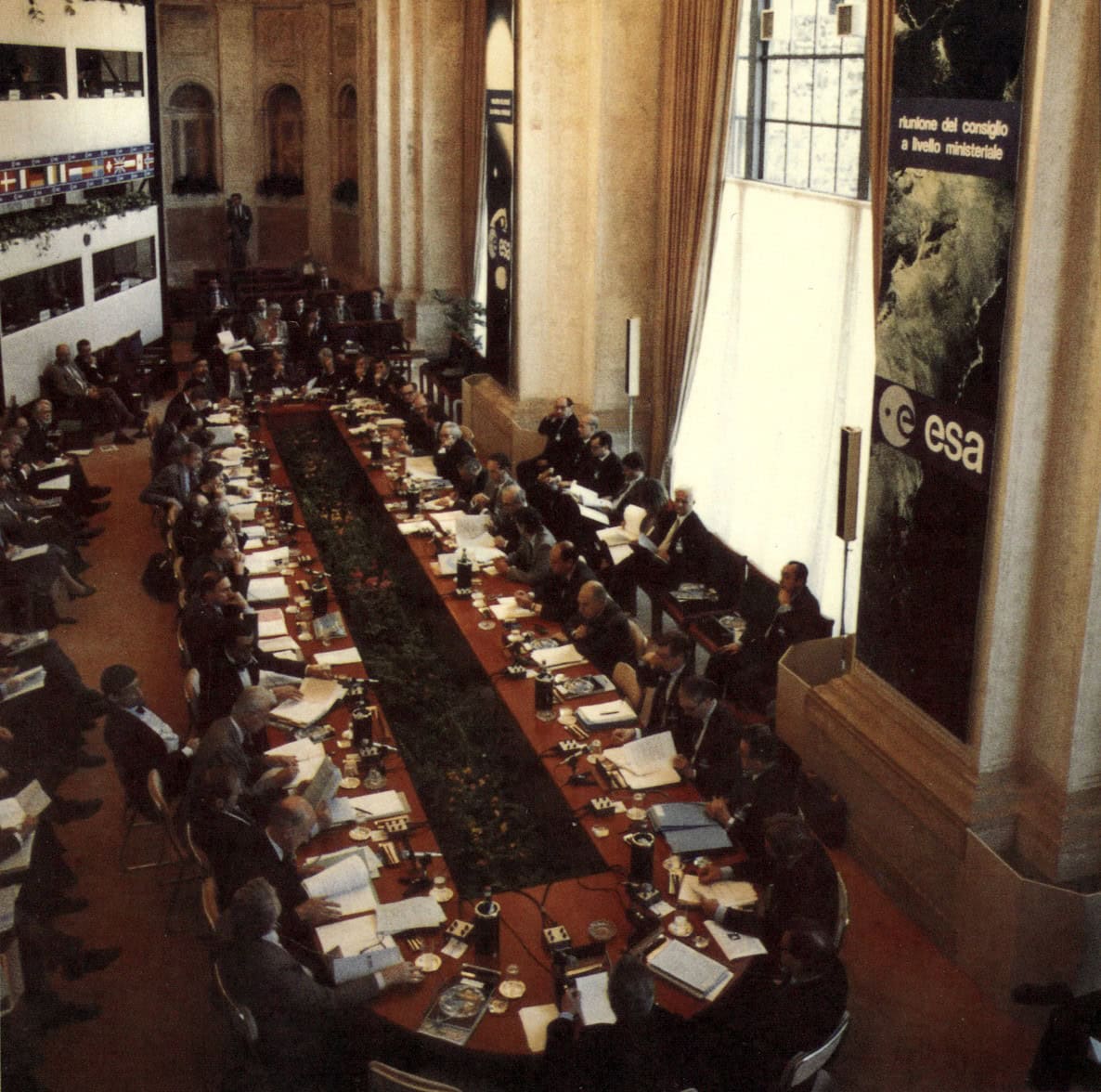
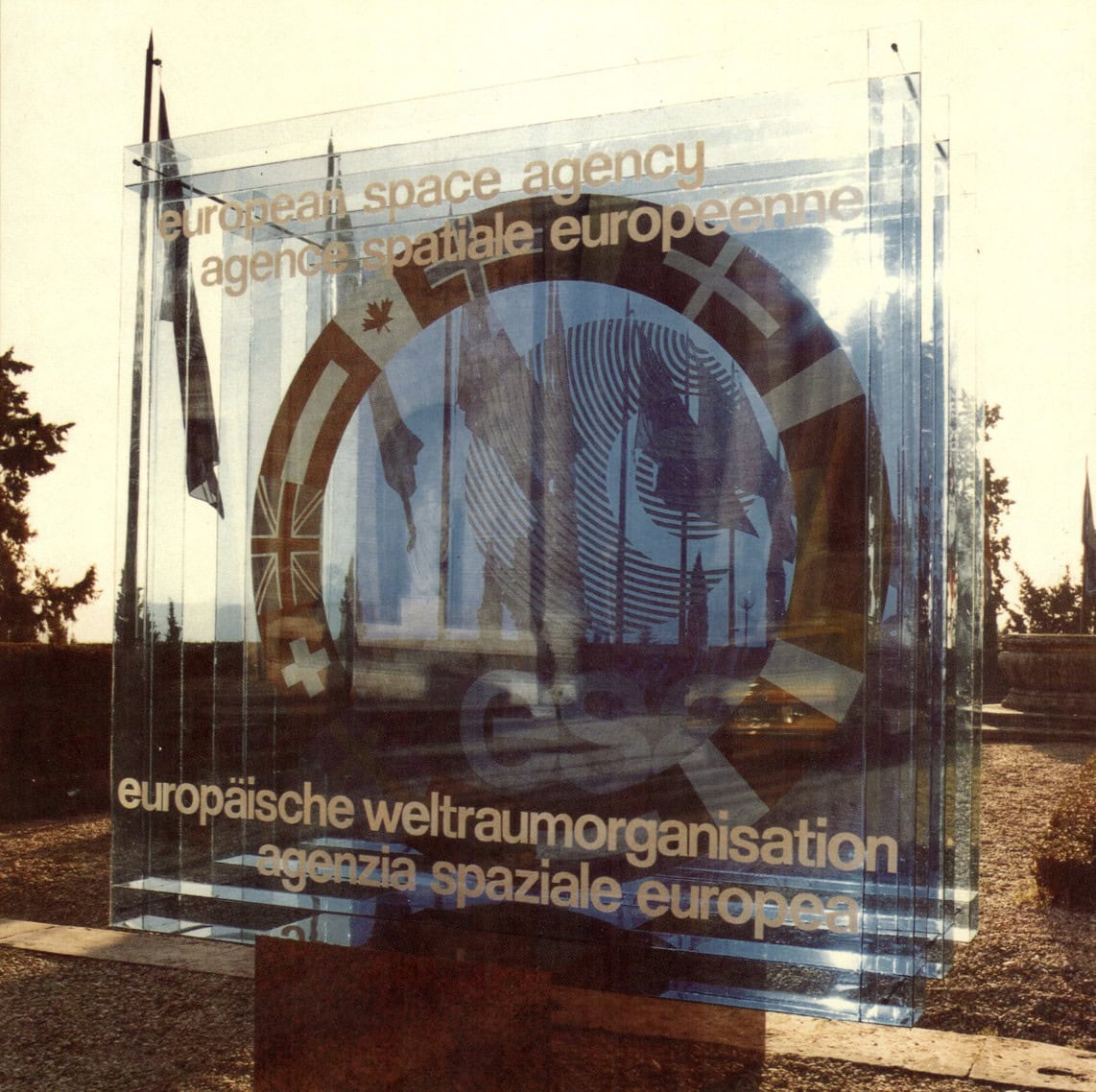
Although it took place ten years after the event, the meeting of ESA Council at Ministerial Level held in 1985 constitutes a final act in the story of the creation of the European Space Agency, as the first Ministerial held after the entry into force of the ESA Convention in 1980. It also represents the latest chapter in our survey of the origins of the Science Programme, with the endorsement of the Horizon 2000 plan for European space from 1985-2000, which we have just opened in the ESA Archives SHIP database.
Planning, preparation and people
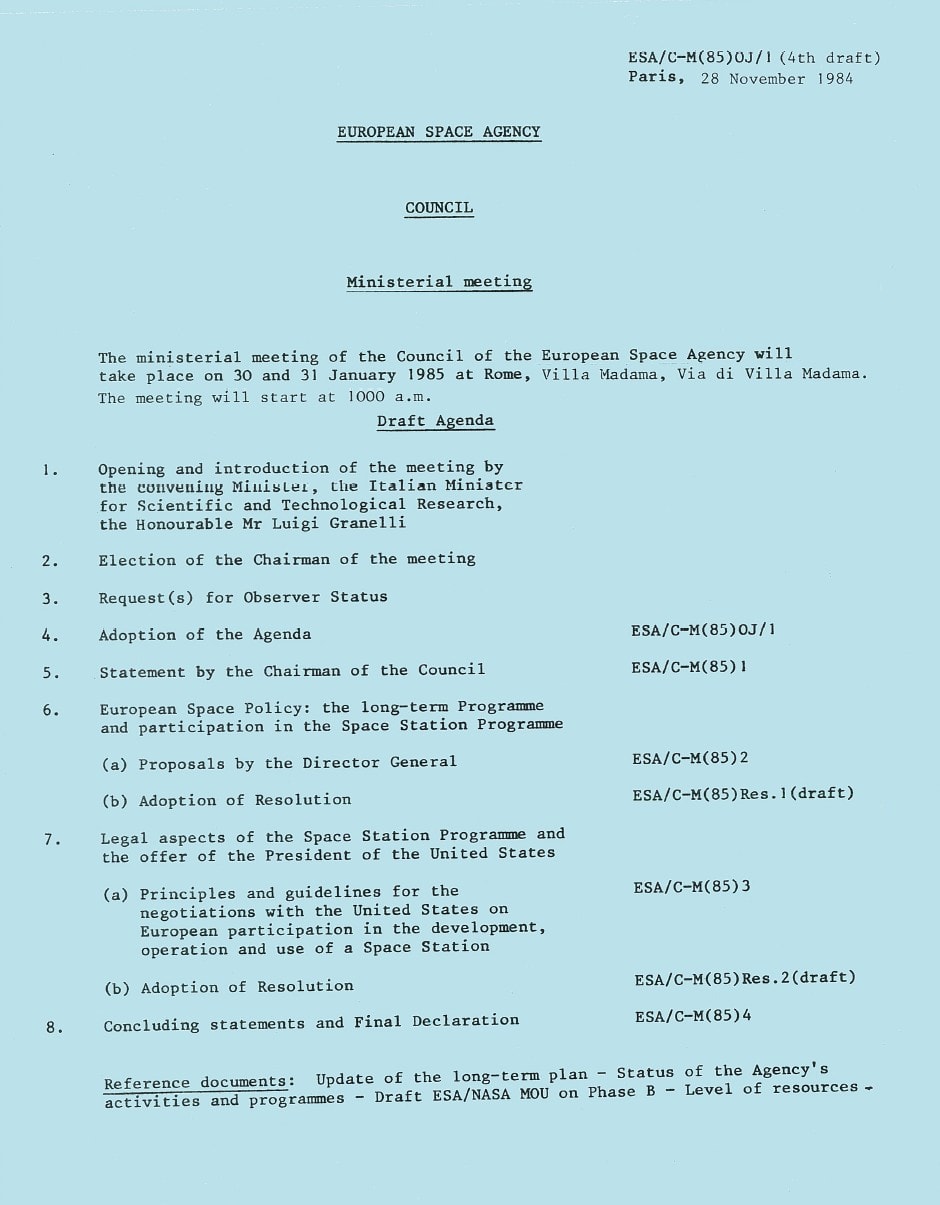
The entry into force of the ESA Convention in 1980 opened the door for the Agency to commence long-term planning, but it was not until 1985 that a new Ministerial Council was held (following the very first one in 1977). This took place at Rome’s Villa Madama on 30 and 31 January and was the final outcome of a chain of discussions and decisions set in motion at the start of the preceding year.
One of the first elements in this was a meeting between ESA’s second Director General, Erik Quistgaard, and the Italian Minister for Scientific and Technological Research, Luigi Granelli, during a Management Board Meeting on 21 February 1984. Granelli was the Minister responsible for convening the Ministerial Conference (since the former Italian Minister Pedini had chaired the previous Ministerial) and agreed to do so at Quistgaard’s request. Preparatory work was clearly underway by spring, with an informal Ministerial working lunch on 9 May (during the week of celebrations at ESTEC for twenty years of European cooperation in space) and a first meeting of the Council Working Group to prepare for the Ministerial on 24 July.
The papers for various 1984 meetings of ESA Council outline other markers in the timeline leading to the Ministerial, beginning with the minutes of a restricted session of Council on 23 February. These confirmed that Council “considered that there should be a thorough discussion of the objectives of a long-term European space policy and agreed that it should devote a special session to it. A Conference at Ministerial level should be convened within a year, to which a package of well prepared decisions should be submitted”.
And towards the close of the year another restricted session, on 13 December, agreed informally on Gijs van Aardenne, Dutch Minister of Economic Affairs, as its Chairman (the formal election of the Chairman is always the first decision taken by ministers at a ministerial meeting).
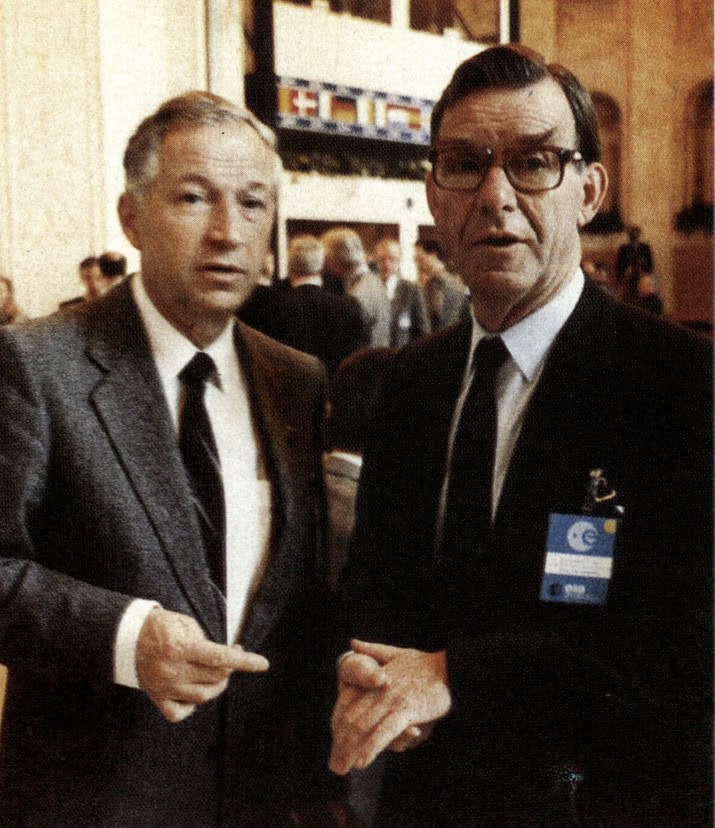
Although the Ministerial had been proposed by Quistgaard, July 1984 saw a change in Director General and the preparatory work within ESA was consequently overseen both by him and ESA’s incoming, third, Director General - Reimar Lüst, who would go on to present the outcomes in Rome in January 1985.
Space policy to Horizon 2000
A cover note to ESA Council on preliminary discussions of a long-term European space policy, from February 1984, explains the need for an overarching space policy within the context of the US invitation to participate in the space station programme and potential Europeanisation of the proposed Columbus human spaceflight programme. It also outlines how this Agency-wide plan would be cascaded down to what became the Horizon 2000 plan for science.
The authors stressed the need for consensus “on a set of objectives for the horizon 2000, such a consensus allowing the elaboration of a long-term programme serving as a framework for the future European space activities.” In other words, the programmes would follow the policy. This is elaborated upon later in the document: “What is proposed above is a set of very high level objectives expressed in general terms. The next step will be to translate these objectives into "technical" goals together with target dates, in the various sectorial fields of space activities. These still broad technical goals will in turn be broken down into individual programmes, and organised in successive steps within a long term programme.”
The note concludes with a timetable for further steps, whereby a long-term programme for all areas of activity would be proposed for discussion at the June 1984 meeting of Council and, following bilateral discussions with national delegations, the subsequent final proposal would be submitted to a meeting of Council at Ministerial level for adoption “at the end of 1984 or beginning of 1985”.
While the Ministerial working groups commenced their meetings, a concurrent planning effort, on a long-term programme for astronomy and solar system science, was already well underway. The introduction to the Horizon 2000 report, published in December 1984 as ESA SP-1070, Space Science - Horizon 2000, tells us that “the study, which led to the long term plan proposed in this document, was initiated by the Director of the Scientific Programme [Roger Bonnet] in September 1983 and was coordinated by a Survey Committee composed of scientists from different areas of fundamental science.”
From the Horizon report and from various working group papers and minutes in the ESA Archives, we can reconstruct the process undertaken. The study itself was carried out between October 1983 and July 1984, with a call for mission concepts issued to the European scientific community in November 1983. This was followed with the establishment of a Survey Committee and a number of topical teams and panels (three topical teams for solar system science, on planetary science, space plasma physics, and solar and heliospheric physics, and an astronomy survey panel) involving about 50 European scientists. The Survey Committee co-ordinated activities and comprised members of the ESA Space Science Advisory Committee and invited scientists from other international scientific research organisations, whereas the topical teams and panel analysed the scientific priorities and requirements of the different research topics and identified how they could be achieved, taking into account the mission concepts and other inputs.
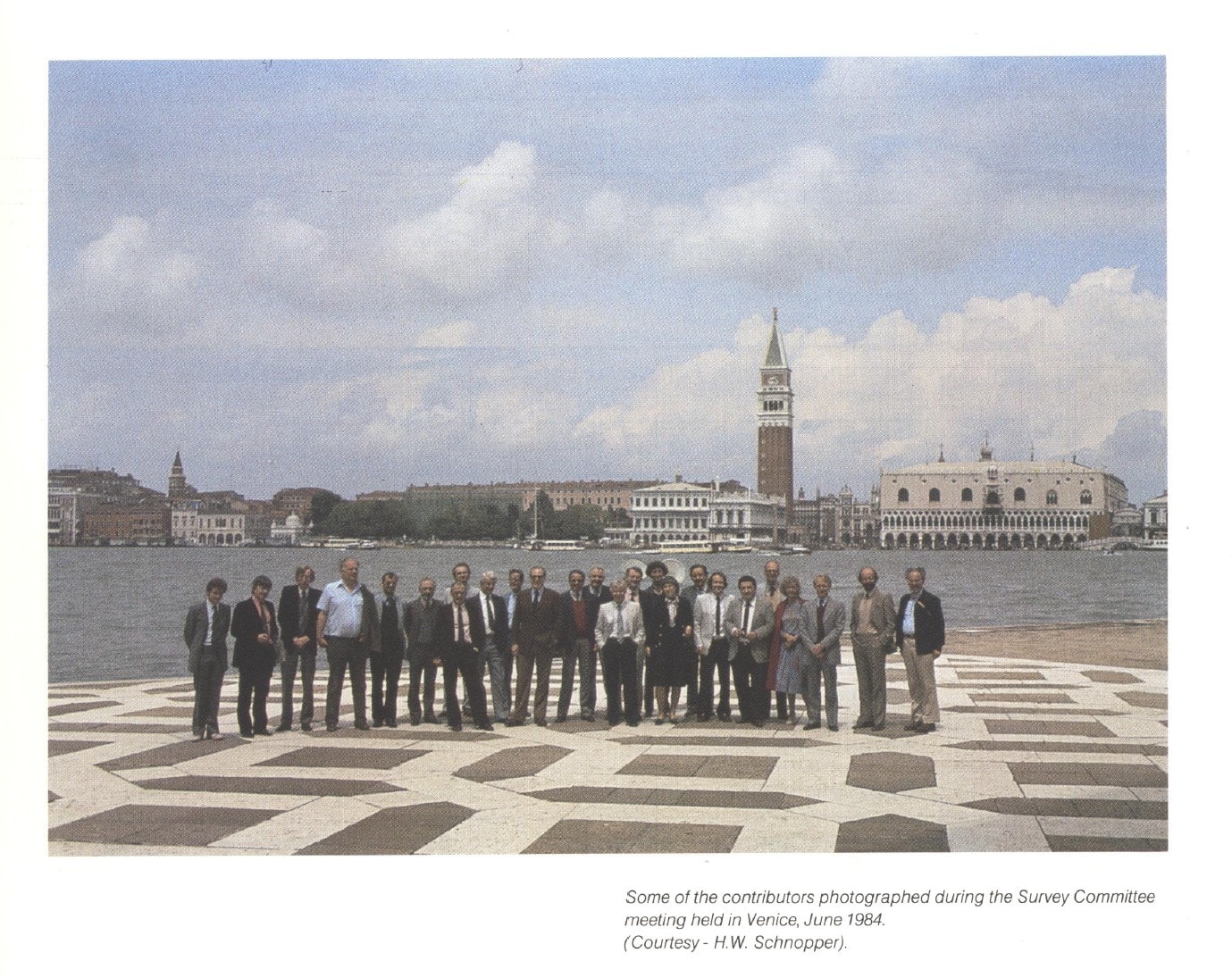
March 1984 saw a plenary session of the topical teams to put together their reports, after which drafts were submitted to the Survey Committee in April. The Survey Committee and topical team and panel chairmen then discussed their findings, and, during a three-day meeting held in Venice in June, constructed a coherent overall programme outlined in the consolidated Survey Committee Report (using the individual reports as its basis, with the topical team reports issued separately as appendices). By November 1984, this had been distributed to the ESA Science Programme Committee and Council, and had been accepted by the ESA executive, with the programmatic and financial consequences included in the overall long term European space policy, for presentation in Rome at the Ministerial meeting.
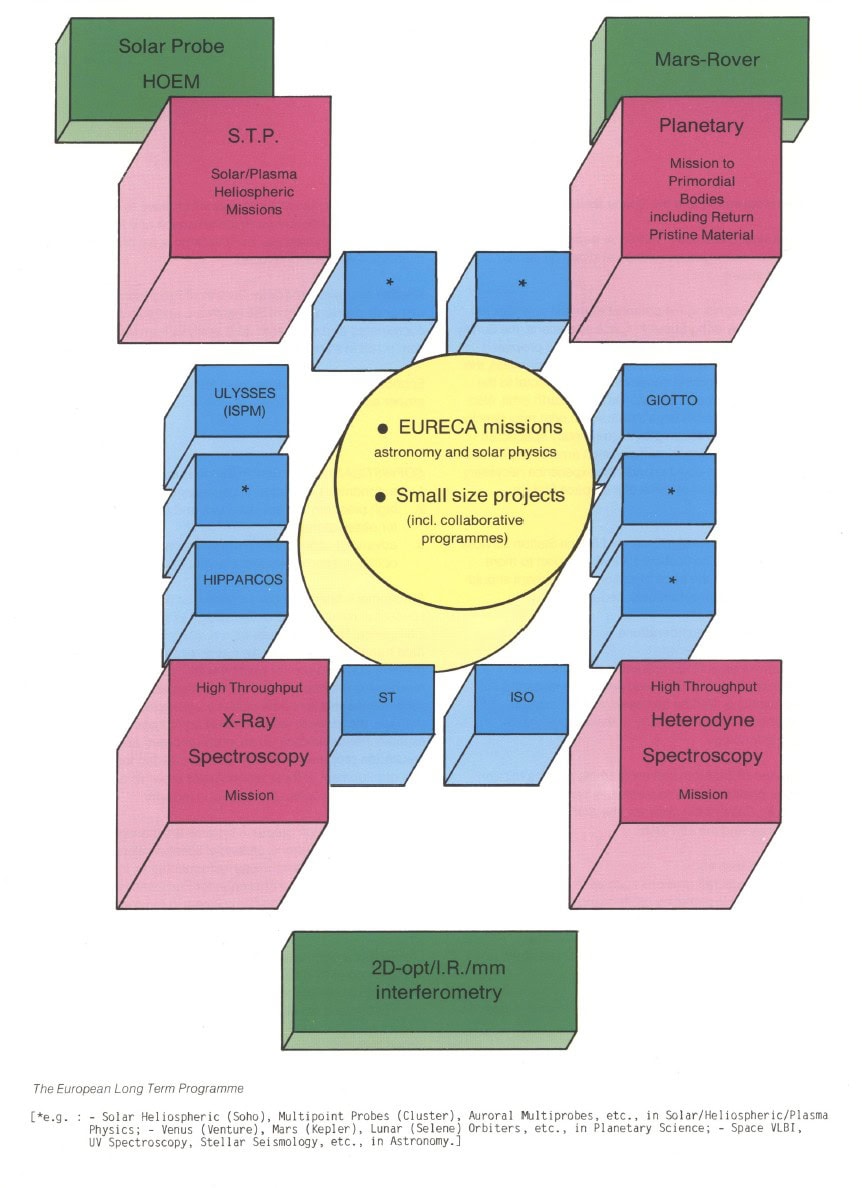
The resulting Horizon 2000 plan for the Science Programme was based on four major science themes in solar/heliospheric/plasma physics, planetary research, and astronomy, to be implemented as flagship missions, along with a flexible part made up of a mix of medium missions and smaller projects. These four ‘cornerstones’ were the Solar Terrestrial Programme, a mission to asteroids or comets, including return to Earth of materials, an X-Ray mission for spectroscopic studies and a spectroscopy mission in the far infra-red/sub-mm wavelengths, and would eventually be realised in the SOHO/Cluster, Rosetta, XMM-Newton and Herschel missions. The plan also identified a number of longer-term science endeavours to be studied in preparation for post-Horizon 2000 missions. Several missions which had already been approved, including Giotto, Hipparcos, the Hubble Space Telescope and Ulysses (both with NASA), and the Infrared Space Observatory (ISO), were also integrated into the plan. In the gourmet-inspired words of an editor of the former ESA Science web pages, “Horizon 2000 replaced the previous a la carte style of mission selection by an appetising table d’hôte”!
Decisions on the day
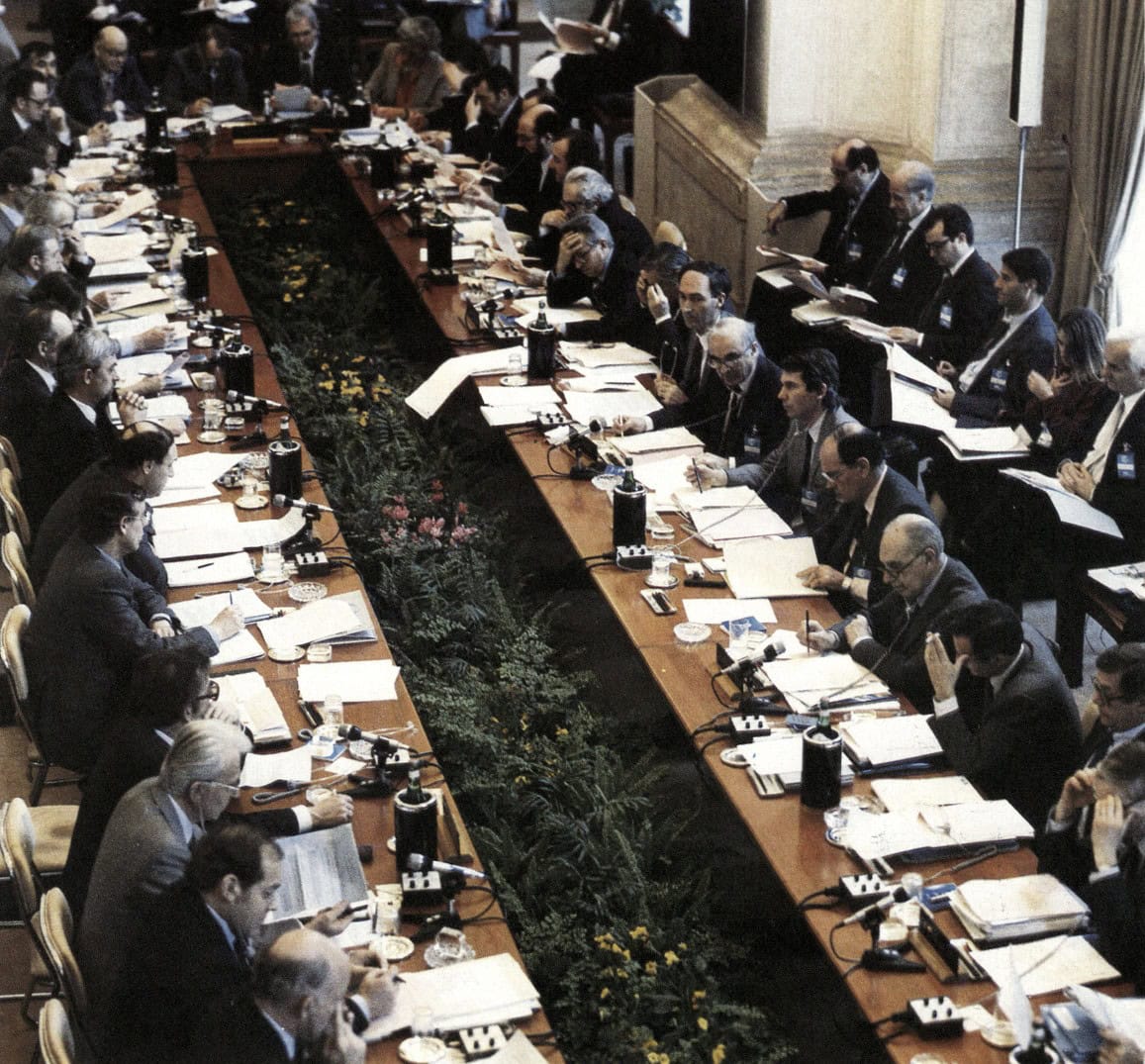
And what of the Ministerial itself? Its main business was for Ministers to give new directives for expanding Europe’s autonomous capability and competitiveness in space. To this end, they adopted two Resolutions on objectives and programmes. The first dealt with the orientation of the overall long-term plan for European space and included approval of the objective to “enable the European scientific community, via an expansion of the scientific programme, to remain in the vanguard of space research”, along with the strengthening of European space transportation capacity and participation in the International Space Station.
The main decisions taken in the second were: agreement of a “balanced long-term European space plan”; the undertaking of the Columbus programme as part of an international space station programme; the development of a new launcher system, Ariane 5; to pursue activities in Earth observation, telecommunications, microgravity and technology; and to study extension of the mandatory science activities to other scientific disciplines.
It also took note of the French decision to undertake the Hermes crewed spaceplane programme and invited France to keep ESA informed on progress, with a view to including Hermes in its optional programmes.
Significance
In terms of activities, it was a first step in the Hermes Programme, studied by CNES since 1978, a response to the offer by US President Ronald Reagan to participate in the Space Station Programme, and a mechanism for redressing more than a decade of frozen funding for the science budget.
Five years after entry into force of the ESA Convention, it was also perhaps the first real Ministerial, where planning and decisions could be made according to its provisions. And where many of the precedents that are still followed today were established, such as, for example, the presence of the Commission of European Communities as an observer.
Consult the published Horizon 2000 plan in SHIP
ESA SP-1070: Space Science – Horizon 2000
Further reading
More about Horizon 2000 in Interview with Roger Bonnet from the Oral History of Europe in Space Collection and in pages 26-30 of the 1984 Annual Report.
Recently opened Bonnet papers in the ESA Archives at the Historical Archives of the European Union.
‘The New Mandatory Scientific Programme’ by R.M Bonnet, in ESA Bulletin 43