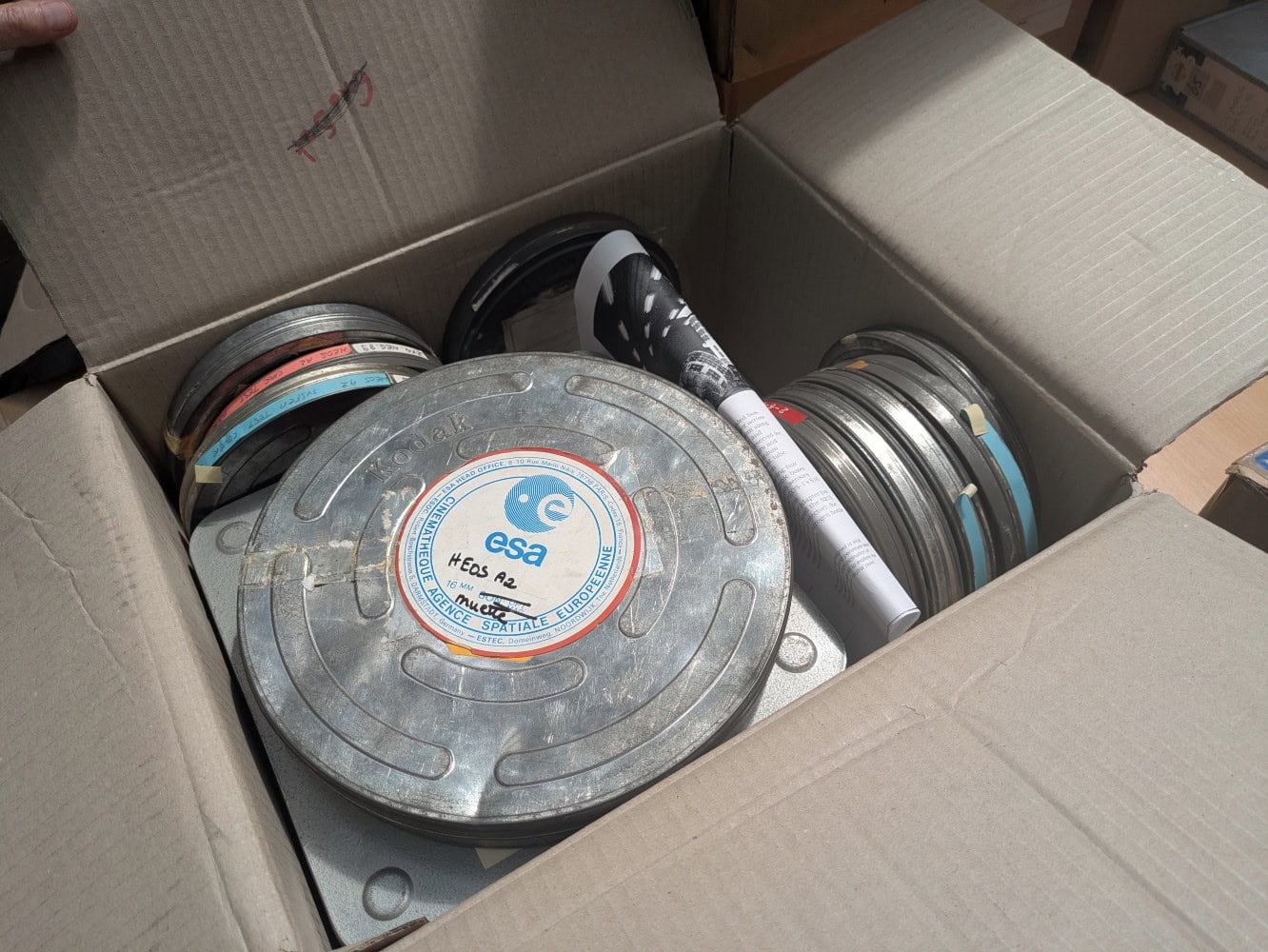
Depending on your generation, the word ‘reel’ might mean rather different things to you. Today we will be going back to the origins of the Instagram reel and looking at how a specialised team in ESA is remastering and preserving historical film footage.
The audio-visual material held within ESA goes back as far as the 1960s and the years of its predecessor ESRO, the European Space Research Organisation. ESRO produced films on 16mm or 35mm film from its creation in 1964 until the mid 1970s, when 1-inch video tapes started to be used. These early films were mainly science films, or documentaries on activities for universities or institutions.
They form the earliest part of an ESA film collection of over 5000 items, managed by the Communications Department and stored at two main locations: around 2000 Betacam tapes kept at ESA ESRIN (in Frascati, Italy) and an older collection including film reels which are held in Paris under a deposit agreement with the Musée de l'Air et de l'Espace.
We caught up with our colleagues Hugo and Juliette in ESA’s Video Team to find out about a current in-house project to digitise the video tapes at ESRIN, see how this is actually done and discover some of challenges of working with film.
Reels, tapes and formats
But first of all, they cleared up the difference between film reels and video tapes, since it turns out there are many! A reel (or spool) of film is made up of a succession of frames. Each of these still images is like a photographic negative or positive (or slide) that together comprise a motion-picture film, chemically captured on a support that was originally made of cellulose nitrate and later cellulose acetate, although the films produced by ESRO largely used a polyester base. A projector is needed to view the film, with the still frames of the strip representing continuous movement when played at the proper speed.
Conversely, video tape is a magnetic tape that records a video signal –like an audio cassette records an audio signal. First invented in the 1930s, tape was cheaper, lighter, and allowed the use of smaller cameras, although the quality was initially lower. It can be viewed using a video tape reader (or recorder) which transcribes the magnetic signal into image and sound for display on a monitor.
The bulk of the ESRIN collection is made up of Betacam tapes, which were developed for professional use and adopted within ESA in the 1980s. Betacam and Betacam SP analogue tapes came first, followed by digital Betacam tapes in the 1990s. However, different formats of video tape existed, including U-matic tapes, of which the ESRIN collection contains just a few examples. (The VHS format which became a household name in the 1980s and 1990s was more fragile, lower quality and generally used by the home video market.)
Continual migration
However, not all items in the collection exist in just one format! In the 1980s selected films were copied onto Betacam tapes using the telecine technique and then some 15 years later further copies were made on digital Betacam, before being transferred onto DVDs around 2010.
A recently featured ESRO film documenting a 1966 sounding rocket campaign is a good example. Juliette explained that the original film had been transferred to tape, from which she was able to create the newly digitised version now online. She pointed out the grain which is the giveaway that the source was film– at least to expert eyes such as hers!
Keeping copies and undertaking continuous migration to more recent formats are important ways of ensuring preservation. But keeping track of copies does create additional collection management needs, for example for reference numbers to differentiate master copies from doubles.
Fragilities and threats
Other preservation issues are linked to the physical properties of the material or to the technology needed to read it. Both film reel and tape, like the microfiches from last month are susceptible to mould, with the risk that spores pass to other areas of the collection. It is therefore important to store them in sealed containers to both prevent the growth of mould and to reduce its possible spread.
Juliette also pointed out the most fragile part of a film reel - the ‘teeth’ - which need to be intact for the film to be attached to a projector. This prompted us to ask whether video tape ever jams inside the reader, as audio cassettes used to do regularly (does anyone else remember using a Bic pen to spool tape back into the cassette afterwards?) Hugo confirmed that a jammed tape can be very costly and that if this happens, the priority is to minimise damage to the video tape recorder (VTR) machine, even if in extreme cases that means cutting the tape. There will always be a copy, but Hugo put our minds at rest that there are ways to save mangled tape if the material is really important. However, fixing a broken VTR is another matter, as they are no longer in production and maintenance is therefore highly specialised.
Thinking about the fragility of analogue material also led to an interesting reflection on their difference from digital formats. Hugo pointed out the irony that analogue Betacam tapes are actually the most reliable format as they are virtually indestructible. While over time they will suffer from an increasing loss of quality, it is rare to lose the total ability to read them, something that can happen very quickly with damaged digital formats (think of a scratched CD) and is known as the digital cliff effect.
Digitisation process
We were fortunate enough to see a demonstration of digitisation, with Juliette using one of the two team VTR machines that date back to the 1990s (pictured below). These originally had three functions – editing, copying and playback – although today they are used exclusively for playback for digitisation. Once the tape is inserted and the play button pressed, the video plays and can be viewed on its dedicated monitor while an attached box – the transcoder – transcribes the magnetic signal from the tape to digital, so it can be read by the linked computer. The last part, which takes place using specialised software on a modern PC, involves viewing the transcribed signal to check it is OK and recording it.
What is actually being recorded is the playback of the tape, meaning that the video has to be left to run in its entirety and making the digitisation a time-consuming process. Constant visual checks of the playback on the monitor are also needed to spot some of the more frequent problems that arise. These can include strange colours or effects such as sections in fast forward. If these appear on both the monitor and the playback viewed through the PC then they form part of the ‘original’ tape (which could be a duplicate copy of an original master copy) and these sections unfortunately can no longer be corrected or recuperated. Alternatively, if they appear only on the PC, then the problem is more likely to be the connection with the transcoder.
Get in touch
While this project involves the digitisation of the tapes according to an established schedule, the team were keen to let us know that they can take requests! To propose an ESA video for digitisation, you can contact the team in ESRIN on spaceinvideos@esa.int.
Work is currently taking place to develop a new online ESA video library which will eventually contain the digitised files from this project and make them accessible to the public.