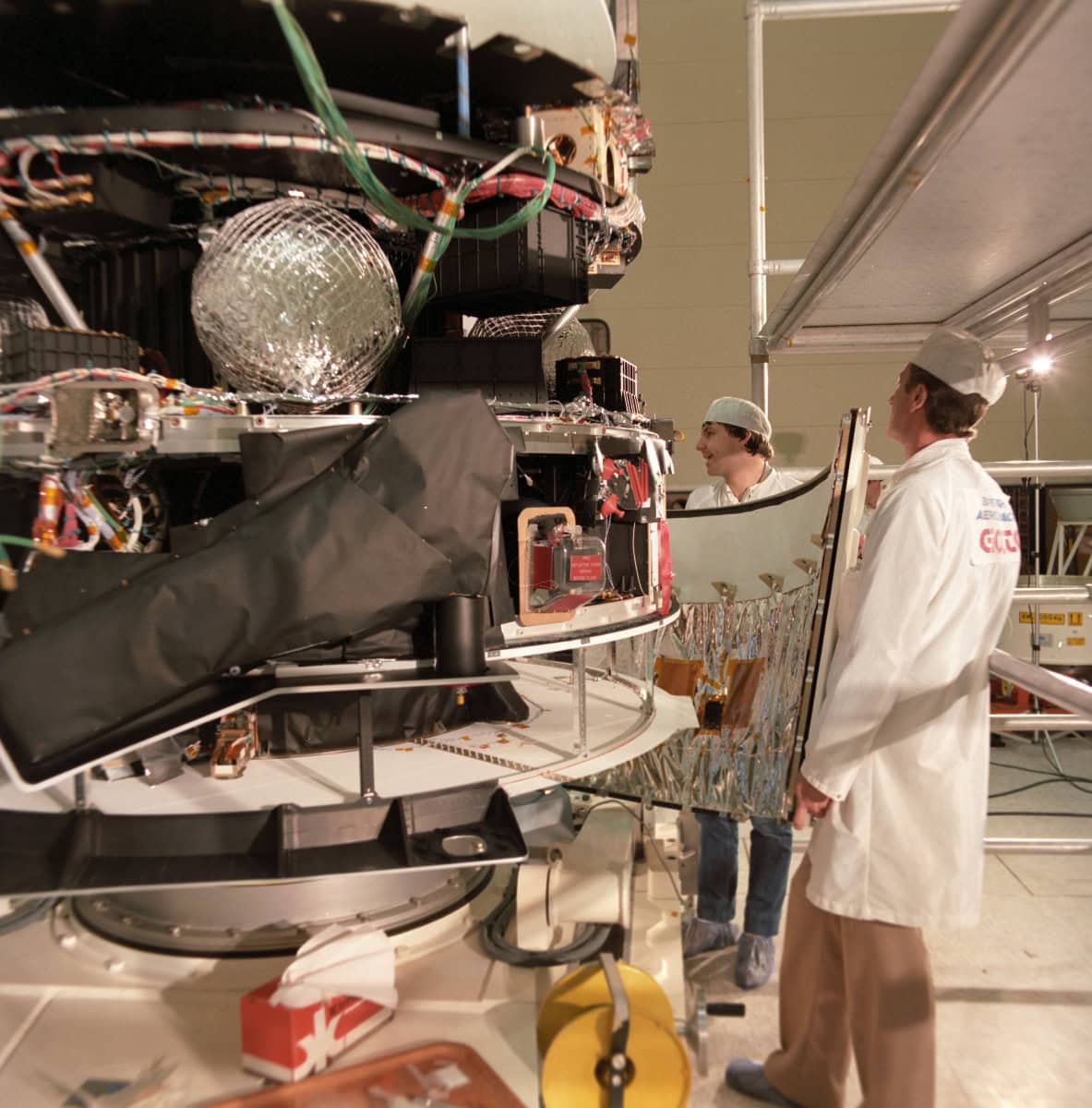
This month a very special opening of material marks the 40th anniversary of one of the most groundbreaking missions from ESA’s first decades: Giotto and its encounter with Comet Halley, which took place in March 1986. Mindful that there are already many published accounts, both contemporary and retrospective, this is the story, not just of the Giotto mission itself, but of its archival legacy. Or, as it turns out, where that might be missing...
Nine-month mission to seven-year odyssey
But first, a lightening round up of the mission, for those who might appreciate a recap!
In the context of our 2026 focus on ESA beginnings, the Giotto mission attained a string of historical firsts for its Science Programme, most notably as first deep space mission, first cometary close flyby, and first reactivation of a spacecraft. It was additionally the culmination of an ambitious international collaboration (with Intercosmos, NASA and the Japanese Institute of Space and Astronautical Science) to investigate Comet Halley during its 1986 apparition.
The first milestone, however, was the approval of the mission to Comet Halley by the ESA Scientific Programme Committee (SPC) in July 1980, just five years after the creation of the Agency in 1975. The following years saw the selection of payload experiments and construction, integration and testing of the spacecraft, alongside coordination with international partners on the Pathfinder Technical Project, through which they would pass information to the Giotto team to pinpoint the nucleus of Comet Halley and help the final targeting of the spacecraft. (These activities are detailed in several ESA publications, listed below, which also explain the tribute to Italian early-Renaissance artist Giotto di Bondone, who depicted Comet Halley in his fresco cycle in the Scrovegni Chapel in Padua, in its naming.)
Giotto was launched by Ariane 1 on 2 July 1985, on its way to the historic encounter, which took place during the night of 13-14 March 1986. During the last seconds before its closest approach Giotto went through a large jet of dust and gas and contact with Earth was temporarily lost after impact from a large particle sent it spinning. But while team members held their breath, bursts of information started to come through. Giotto’s thrusters were able to stabilise its motion, and contact was restored.
Giotto eventually sent back over 2000 images and data from its science instruments, changing our picture of comets and increasing our knowledge of the origin of the solar system. Its images of the nucleus confirmed that it is potato shaped, not spherical, and largely made up of dust with embedded ice, rather than the other way round. Dust which Giotto discovered was organic and rich in elements essential for life.
A mission originally planned to last just months then became a seven year ‘odyssey’ (in the words of ESA BR-83) culminating in an unprecedented encounter with another comet; Giotto was reactivated in 1990 for the Giotto Extended Mission (GEM), for a flyby of Comet Grigg-Skjellerup, with closest approach at about 200km on 10 July 1992. This new mission itself provided new data and insights into the interaction of solar wind with a non-magnetised body in space.
In a helpful summary, a 1996 report to the SPC on the GEM outlined the entire ‘timeline’ from launch to second encounter, with notes on historical significance - it can be seen in the slideshow below.
Valuable documentary fragments
Today, the ESA Archives at the European Centre for Space Records (ECSR) at ESRIN contain various documentation from the Giotto mission(s). This ranges from SPC papers, contracts, press releases, publications and conference proceedings, along with two rather special sets of papers, which shed particular light on the 1986 encounter and give an overview of publicity for both the Giotto and GEM missions.
The first of these is a copy of the 370-page Giotto Encounter Operation Manual, produced in 1986 for visiting scientists and their operations staff. Strangely, the document is part of a series from the Telecommunications directorate (not Science) on the DIANA project - Direct Information Access Network for Africa. DIANA was an ESA collaboration with the UN Food and Agriculture Organization to establish a satellite-based informatics network between FAO and various places in Africa. The connection between DIANA and Giotto is not apparent (possibly through an engineer involved in both Giotto and DIANA)!
Divided into ten different sections and including schedules, organigrams, maps, protocols and lists, the manual covers the entire organisation of operations for the encounter on 13 March 1986, broken down into: general information; ESOC infrastructure/logistics (including telephony); key participants; safety and security; ground segment; payload; targeting; flight operations procedure; PR activities; and annexes on scientific data, parameters and decisions made during the final days and international agreements for data exchange.
The section on public relations gives details of the live international TV coverage that had been set up with ZDF in Germany (with transmission to EBU for global distribution), TV FR3 in France and the BBC in UK, and of VIP events, press conferences and associated PR material.
Three schedules have been included in the slideshow below, for the flight operations, press conferences and VIP presentations planned around the encounter, giving a flavour of the huge organisational machinery behind it.
The second set of documents came to the ECSR from a collection of papers held by ESA’s former Inspector General, Massimo Trella, most probably the outcome of a personal interest in the mission and its Italian connection. The content is a ‘digest’ of publicity and events linked to both Giotto missions, supplemented by SPC and operational reports from the GEM. The PR element of this includes press releases, timelines, actions and memos for PR activities for the first encounter; correspondence on the German philatelic tie in and design of special postmarks in 1986; a small set of ESA papers with preliminary results from 1986; and invitations and invite lists for the second encounter in 1992.
However, one rather large gap in all this is the technical archive itself. The Giotto mission pre-dates the establishment of the European Centre for Space Records (ECSR) at ESRIN, in 2003, to host the technical archives of ESA’s activities. We simply do not know what happened to the material from this landmark mission in the intervening time, only that it has never made it to the ECSR.
Naturally, it is impossible to preserve information without the relevant material, leaving us with the situation where our ability to exploit the enormous technical accomplishments of this mission for the future is compromised.
Photographic records
Happily, this is compensated to an extent by the pictures of Giotto in the historical photograph collections of the Archives. These document in images (from 1983 onwards) the process of testing and integration of the spacecraft, pre-launch final testing in Kourou and the launch campaign in July 1985. There is also a series of photographs from the 1986 encounter where, thanks to the staff lists in the Operations Manual (and some invaluable input from the colleagues who came after them) we have been able to give names to some of the faces which weren’t included in the original descriptions. The collections are completed by a small group of images of Comet Halley taken by the Multicolour Camera and a final series by the ESA photographers capturing the event at ESOC for the encounter with comet Grigg-Skjellerup on 10 July 1992.
A dual legacy
Even in the absence of the project material to draw on, Giotto’s technical legacy is uncontested. Its images of Comet Halley showed for the first time the shape of a comet nucleus and it found the first evidence of organic material in a comet. Furthermore, its extended mission to Comet Grigg-Skjellerup made the closest comet flyby by any spacecraft at that time. In the words of Encounter '86. An International Rendezvous with Halley's Comet (ESA BR-27), “Man’s knowledge of the origin of the solar system has edged a little further forward, and the way is open for fresh explorations”. Indeed, after Giotto, the torch of comet science was handed over to Rosetta, launched in 2004 on its decade-long journey for its own historic rendezvous with comet 67/P Churyumov–Gerasimenko in 2014.
Back in May 1986, ESA’s Director General Reimar Lüst touched on another aspect in a cover letter to a press release with scientific results from the first Giotto encounter: “I should like to take this opportunity of thanking the Press for the interest they have shown in this. Whilst ESA has perhaps not yet become a byword for space activities in Europe to the extent that the name of NASA is recoqnised world—wide, I believe that, with your help, our endeavours are becoming better known to the man in the street”.
With the benefit of hindsight, we can see the enormous effect that Giotto had on ESA’s profile, with its achievements broadcast into homes across the world thanks to the international coverage and presented to public figures including Pope John Paul II. But even before that, the unprecedented response to the children’s art competition showcased the enduring fascination of Comet Halley and demonstrated how this mission captured the imagination of a new generation.
So while the fragmentary nature of the Giotto archival holdings is frustrating, they yet remain an invaluable resource for reconstructing this record of its impact.
Special opening - newly digitised Giotto documents
Giotto Encounter Operations Manual
ESA SP-1127 - Images of the Nucleus of Comet Halley
Photos from the 1986 encounter in SHIP
Other digitised or online material on Giotto
Encounter '86. An International Rendezvous with Halley's Comet (ESA BR-27)
Giotto. The Second Encounter (ESA BR-83)
Giotto's second encounter. The Mission to Comet Grigg-Skjellerup (ESA BR-93)
EUI online exhibition on the Giotto children’s drawings (from an ESA art competition for children under ten in Europe)
Access to all Giotto science data
All Giotto science data can be found in ESA’s Planetary Science Archive