May 2025 marked the fiftieth anniversary of the signing of the ESA Convention and the start of the first 50 years of ESA. This month we fast forward by just over a decade, taking a special publication produced for the Silver Jubilee celebrations as the starting point to turn a spotlight on 1989: a year in which Europe witnessed historical milestones and momentous changes, along with the first systematic efforts within ESA to safeguard the memory of the continent’s endeavours in space.
What was the Silver Jubilee and why in 1989?
While 1975 is the date of the creation of ESA, 1989 was the 25th anniversary of another landmark date – 1964. This was the year of the establishment of the first European space organisations - ESRO and ELDO - who came together in 1975 to form ESA. The series of events for these Silver Jubilee commemorations of European cooperation in space spanned 1989, and included a major event and exhibition in Paris, staff celebrations at ESA establishments, an essay competition for European students and reunions for pensioners.
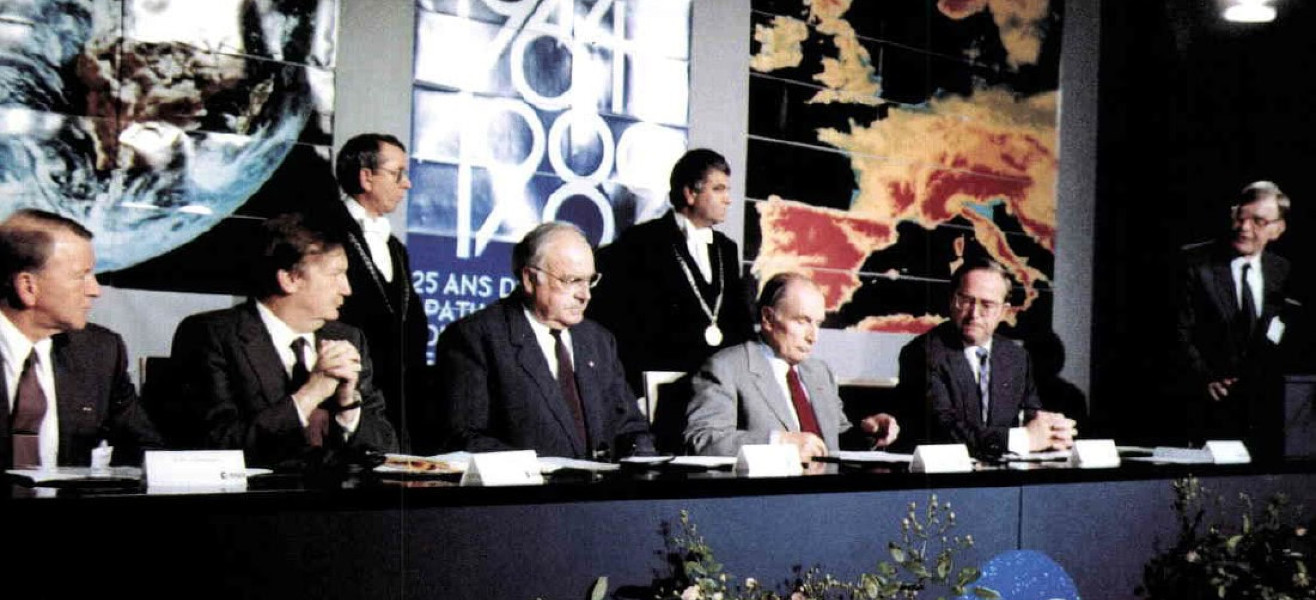
The most prestigious of them was the Paris conference and gala dinner that took place on19 April 1989 and a special publication was commissioned for the occasion - European Space: 25, a Silver Jubilee Celebration, 1964-1989.
The 230-page volume presented the achievements of the first 25 years through photographs illustrating ESRO and ESA projects (subdivided according to their nature), a section on ELDO and a part dedicated to future programmes. In line with Director General Reimar Lüst’s affirmation in his preface that it was “people who made the story, and where possible it is the human involvement which we have sought to bring out’’, there were also chapters covering special events and on past Directors and Secretaries General. It was probably the first attempt to offer a complete pictorial history of European space, following on from the smaller booklet and publication produced in 1984 for the twentieth anniversary, which focused on the chronology of European space and recollections written by those involved.
The conference itself was opened by Lüst and was attended by European heads of state including two key figures from the European Economic Community: President Mitterand of France and Chancellor Kohl of the German Federal Republic. Renowned for their work throughout the 1980s towards increased European reconciliation and integration, their presence was a clear demonstration of European commitment to innovation in science and technology, topics whose importance continues to resonate today. As does another achievement noted in the preface by Lüst: “European space ventures have shown the way in which barriers can be lowered in pursuit of peaceful objectives”.
But while ESA looked to the future, no one knew just how soon events on the wider European stage would usher in this new era and literally tear down barriers.
Commemoration, reunification and union
The summer of 1989 began on 14 July with the commemoration of a past event which had shaped European history – the 200th anniversary of the French Revolution. The bicentennial celebrations for the French Republic centred around the Marseillaise procession held in Paris on Bastille Day. It was attended by world leaders who were in the city for the G7 World Economic Summit, opened by President Mitterand at the newly inaugurated Louvre pyramid on that afternoon.
But by the autumn of 1989, the eyes of the world had turned to the present and on the gathering momentum of events unfurling across Eastern Europe, which led to the fall of the Berlin Wall in November and the dismantling of the Iron Curtain which had divided the continent for over four decades. Within just a year, the former East Germany was admitted to the EEC as part of a reunified Germany, and this reunification itself took place in the context of the foundations being laid for today’s European Union. The EU was created shortly afterwards by the Maastricht Treaty, approved in December 1991 and which entered into force in November 1993.
Efforts to preserve memories
All of these events, from 1789 via 1964 and 1975 to 1989, were watershed moments for Europe, and all had in common the need to be recorded for future generations.
Within ESA, the Jubilee events and publication were both the outcome of work began in the 1980s to consolidate ESA’s historical records and the driver of further initiatives.
The research undertaken for the publication no doubt benefitted from the former, while the events themselves brought together many of the ‘pioneers’ of European space from the 1960s, who were increasingly mindful of the need to set down their memories in print and secure their legacy.
With institutional support from two of their number - George van Reeth as Director of Administration and Director General Reimar Lüst - their concerns were translated within the year into the establishment of the long-running ESA History project and an agreement with the Historical Archives of the European Union for the deposit of the Archives related to ESA’s predecessor organisations.
Lüst’s involvement as the Scientific Director of the COPERS preparatory commission stemmed from its early days in 1962, and continued with ESRO, the organisation it brought into being. Van Reeth joined ESRO in its infancy and over his 30-year career in European space, went on to work for all three of its formal organisations – ESRO, ELDO and ESA. They were therefore uniquely qualified as advocates, embodying many of the memories that these projects aimed to preserve.
Read more
As part of our 50-year commemorations, and as a piece of history itself, we have made a high-resolution digistised copy of the 1989 Silver Jubilee volume available online. This can be accessed in the SHIP database: European Space: 25, a Silver Jubilee Celebration, 1964-1989.
ESA Archives at HAEU, including COPERS, ELDO and ESRO.